Birthdays

Today was my dad’s birthday and tomorrow is my daughter’s birthday. He would have been 64. She’ll be four.

They never met, which is one of the great tragedies of my life, because my dad died three weeks after he turned 47. I was 24 at the time and while I understood intellectually that he was too young to die, I only now understand, at age 41, how young, exactly, 47 is.

My dad would have been a gruff old guy, I suppose, but I know that under his exterior was the heart of a man who laughed with such gusto that he could have been a professional sit-com attender. Actors would have paid him money to hear his laughter at the right spots. He had the biggest laugh I’ve ever heard.

The dad-shaped hole he left in my life has not healed. If anything, it has frayed a little, become worn with age.

But in the long years since he’s been gone, my heart has filled up with the love of the ones who came to stay: my husband, my twin boys, my miracle son, and my unexpected daughter who was born on Labor Day, which continues to amuse me.

I’m baking cupcakes and I bought balloons and we’ll swim and play at her pool party tomorrow. And only once or twice will I think of her grandpa who never knew her. I wish they their lives would have overlapped, even a bit.

Loss and love, intertwined, intersect as September 1 ends and September 2 begins.

Happy birthday, Dad. Happy birthday, Baby Girl. I wish you had met.

(Last year, same thoughts. Different words.)

Father’s Day

Father’s Day never fails to make me think about my father.  That’s the whole idea, right?  The problem is that thinking about my dad brings back the summer of 1989, the last time I saw him on Father’s Day. 

A few days before, he’d heard something on Paul Harvey’s radio program.  He told me, “Be sure to listen to Paul Harvey on Sunday.”  Then he asked if it would be okay with me if he spent he day visiting his best friend, Jim, a few hours away.  I said, “Of course,” and on Sunday, I listened to this:

 What Are Fathers Made Of?

A father is a thing that is forced to endure childbirth with an anesthetic.

A father is a thing that growls when it feels good . . . and laughs very loud when it’s scared half to death.

A father is sometimes accused of giving too much time to his business when the little ones are growing up.

That’s partly fear, too.

Fathers are much more easily frightened than mothers.

A father never feels entirely worthy of the worship in a child’s eyes.

He’s never quite the hero his daughter thinks . . never quite the man his son believes him to be . . . and this worries him, sometimes.

So he works too hard to try and smooth the rough places in the road for those of his own who will follow him.

A father is a thing that gets very angry when the first school grades aren’t as good as he thinks they should be.

He scolds his son . . . though he knows it’s the teacher’s fault.

A father is a thing that goes away to war, sometimes . . .

And learns to swear and shoot and spit through his teeth and would run the other way except that this war is part of his only important job in life . . . which is making the world better for his child than it has been for him.

Fathers grow old faster than people.

Because they, in other wars, have to stand at the train station and wave goodbye to the uniform that climbs aboard.

And while mothers can cry where it shows . . .

Fathers have to stand there and beam outside . . . and die inside.

Fathers have very stout hearts, so they have to be broken sometimes or no one would know what’s inside.

Fathers are what give daughters away to other men who aren’t nearly good enough . . . so they can have grandchildren that are smarter than anybody’s.

Fathers fight dragons, almost daily.

They hurry away from the breakfast table . . .

Off to the arena which is sometimes called an office or a workshop . . .

There, with calloused, practiced hands they tackle the dragon with three heads . . .

Weariness, Work and Monotony.

And they never quite win the fight, but they never give up.

Knights in shining armor . . .

Fathers in shiny trousers . . . there’s little difference . . .

As they march away to each workday.

Fathers make bets with insurance companies about who’ll live the longest.

Though they know the odds they keep right on betting . . .

Even as the odds get higher and higher, . . . they keep right on betting . . . more and more.

And one day they lose.

But fathers enjoy an earthly immortality . . . and the bet’s paid off to the part of him he leaves behind.

I don’t know . . . where fathers go . . . when they die.

But I’ve an idea that after a good rest . . . wherever it is . . . he won’t be happy unless there’s work to do.

He won’t just sit on a cloud and wait for the girl he’s loved and the children she bore . . .

He’ll be busy there, too . . . repairing the stairs . . . oiling the gates . . . improving the streets . . . smoothing the way.

–Excerpt from Paul Harvey News, American Broadcasting Company, Father’s Day 1950.

That June day, my dad expressed to me what he never could put into words or even hugs.  His childhood had broken him in ways he never articulated; his heart was crippled all his life.  I remember him hugging me maybe three times in my whole life, but I know that he loved me.  Paul Harvey’s words about fatherhood that summer day reassured me of that plain fact.

I worried about my dad that summer.  In May, he’d been diagnosed with two brain tumors which were the result of metastasized melanoma, the deadly form of skin cancer.  The doctors predicted he’d live anywhere from four months to two years.  

My husband and I lived with him that summer, which was arguably the worst summer of our lives.  Although the sun shone, the shadows were dark and cold in our hearts.  My dad–never a cheerful guy to begin with–was grouchy and took out his anger on my dear husband who had the nerve to put the spoons in the wrong slot in the drawer and failed to turn off the laundry room light.

On the last day of summer, September 21, 1989, my dad died at home, in the same lavender-walled room where I’d spent my adolescence.  He was 47 years old. 

*  *  * 

I talked about my dad before here and here.

Why Boring Is Good

This afternoon, I thought, if only something would happen.  And then I wondered if I’d lost my mind.  After all, something could be something bad, and one should not resent the doldrums when they settle like stale air. 

Boring is good!  Boring means we don’t need to call an ambulance to rush a bleeding body to the emergency room.  Boring means we don’t have to telephone a lawyer to find out exactly what to do with the jackpot. 

Boring means I don’t need a new outfit and I won’t have to wear pantyhose and shoes that make the balls of my feet throb.  Boring means the kids are all in their rooms, safe and sound, busily digesting and growing another inch before morning.

But when things are so boring, I have to dredge up material from the deep recesses of my mind and boy, things are kind of dusty in there.  I find an old picture of my dad, the one I took the day he left on a sailboat to sail down the coast to California.  Steroids prescribed to shrink his brain tumor had bloated his face, but he smiled with pure joy that day.  Cancer had been his ticket out of a job he despised and he ate hot fudge sundaes and grabbed as much life as he could.  Then he died four months after the diagnosis.

That photograph hangs in my hallway and tonight, while I held my crabby nap-free daughter, I saw my dad’s face looking in at me.  He’s been gone since 1989 and I still can’t figure out what to do about that gaping vacancy he left.  It’s unfillable.

After my dad died, I was absolutely convinced that I would be next.  Nothing like stark terror to bring excitement to your twenties!  I even found a breast lump, had a mammogram, followed by an ultrasound, resulting in a surgical biopsy. 

That morning, the surgeon drew purple arrows on my skin, pointing to the spot.  Next thing I knew, I was stretched onto the operating table, arms straight out, finger-clip catching the rhythm of my beating heart. 

The sun shone into the room and upbeat music played while I laid exposed.  The needle numbed me.  I felt the tug of the knife, heard the sizzle as the wound was cauterized, smelled the burning, saw smoke.  The doctor said, “Looks like a lipoma.  Good.” 

And so I didn’t die from cancer.  It was nothing. 

A few years later, when our twins were two, my husband’s voice started to sound scratchy.  We had no health insurance, so he put off seeing a doctor, but finally, some church members insisted that he go.  So, he did. 

The first specialist assured him everything was fine.  Rest the voice, he said.  And so my husband was mute for a week.  When he didn’t improve, he saw a second specialist.  This doctor told him the growth on his larynx needed to be removed, but that it was probably nothing.

We drove to Midland, Michigan, for the surgery.  A friend cared for our boys while I sat in the waiting room.  Afterward, the doctor met with me and assured me, “You have a greater chance of being hit by lightening on the way home than of that being cancer.  But we’ll send it to the lab for a biopsy anyway.  One chance in a ten thousand,” he said.

And so, a few weeks later, we were shocked when it turned out to be cancer.  Cancer?  Laryngeal cancer threatened to steal his voice.  He went back into surgery so the doctor could make sure he got it all. 

And weirdly enough, that was that.  All of his follow-up visits showed no sign of cancer.  We hardly even remember that terrible chapter in our lives.

The thing is, boring can turn into catastrophe in twenty minutes or less.  And when things are dull, life is good.

You heard it here first.  

Life is Too Short

A couple of weeks ago, my mother brought my grandmother to my house for Easter lunch. When they left, Grandma paced inch-by-inch down the sidewalk, clutching her walker, while my mom leaned on her cane and limped to the car. I walked them out and as Grandma was attempting to fold herself into the front seat while my mother stood with one hand attempting to quell the pain in her back, I quipped, “Hey! I see my future right here,” and I swept my hand at the scene and said, “and I’m scared!”

They both laughed at my feeble joke, but the truth is, I wasn’t joking. I bent down and lifted my grandmother’s swollen foot up into the car and she winced and groaned at the pain. The hip joint has deteriorated and even that tiny movement shot searing pain up her leg and to her hip. She even said, “Oh, that hurts,” which is as dramatic as she gets.

I never liked being young. I was eager to get through my teen years as quickly as possible. I didn’t savor my high school years or wish that time would slow down. I could hardly stand the excruciatingly slow pace of adolescence and the walled off borders of teenage-dom. I wanted out and I wanted out yesterday.

My college years raced by, though, in a blur of longing and confusion and fretfulness. And before I knew it, I was married. My twenty-sixth birthday depressed me, but only because we had been trying to start a family and ended up caught in a maze of infertility and adoption attempts and all I wanted was to be a mother. I wanted to be a mother more than I wanted to sleep in, more than I wanted to have a career, more than I wanted chocolate chip cookies. So, when I turned twenty-six, I moped around.

But before I knew it, I was a mother (to twins!) and then, in a flash, I turned thirty. And the thirtysomething years marched on and then, what? My fortieth birthday arrived. By then, I had four children and I was trying to remember just exactly why I had been so desperate to be a mother. Okay, not really. Okay, well, not most days, only occasionally because, hello? I never get to sleep in anymore.

My dad died when he was forty-seven. So, on one hand, I am so thankful for every day of living and so aware of the alternative to aging. On the other hand, I see my mother’s eyelids sagging lower and lower as if are too tired to stand up any longer. And I look at my grandmother, lingering a century on this earth, and I dread the day when my eyesight fails and darkness falls, even on a sunshiny day.

How is it fair that just as you become comfortable in your own skin, your skin gets speckled with age spots and bunches in wrinkles around your knuckles? Just when you figure out what to do with your hair, a new stripe of gray appears with a wiry texture. And even your knees betray your age with tiny purple spider veins appearing over the winter under cover of your pant legs. Aging is like receiving a package in the mail that you did not order and you cannot return.

But, oh, the alternative is to never breathe in another lilac spring day and to never watch the tulips grow taller day by day.

Life is too short. Even when you live to be a hundred, like my grandmother, life is too short to focus on the flaws, on the missing pieces, on the crooked places you wish were straight. Life is too short to not take chances, to not speak up, to not stand tall. Life is too short.

Old age will come, ready or not. In the meantime, I will sear into my memory the vision of my daughter dancing a high-step in the back yard and the faces of my boys as they carry homemade bows and arrows made of bamboo in improvised sheaths on their backs. I will appreciate my body sweating on my exercise bike and I will be mindful of the fuel I give my body. I will smile at my face in the mirror and be grateful that I can clip my own toenails. I will snip an armful of lilacs to carry into the house, even though they’ll fade and die in the vase in a week and they’re such a pain to clean up.

Because today, I welcome the fleeting beauty of lilacs into my home. Life is too short and soon, the lilacs will be gone. My boys will abandon the backyard for the wider world. My daughter will find better things to do than to harass the ants on a fine spring day. The neighborhood boys won’t trample mud into my carpet. I’ll have an uninterrupted telephone conversation and I’ll think, oh, I remember when–

Act fast. Get yours now. Life is too short. Already, the tulip petals have fallen. But you can get in on the lilacs if you hurry.

What a Shame: I Can’t Get No Satisfaction

The last art class I took was in eighth grade. I loved Mrs. Parr, the tightly-controlled, but quiet young art teacher. She assigned us to draw an item encased in a bottle. I drew a man upside down, stuck in the bottle. I adored watercolor painting and still have the fruit bowl “still life” I painted. My creative-souled father seemed to have passed his artistic gene to me.

And yet, the second I entered the ninth grade, I avoided all art classes. I did sign up for chorus, which was an 80-voice choir. I sat in the middle, between the sopranos and altos and, although I considered my voice unworthy of singing solos, I sang in tune and enjoyed the respite from academics. Until, of course, the choir teacher gave me a B+ for my final grade and destroyed my perfect grade point average. (Yes, I’m still bitter.)

That only proved my point. Avoid subjects graded subjectively. Art? No. Music? Never. Not if I can’t guarantee the outcome.

I thought of this again last night when I watched the Seattle Seahawks lose the Super Bowl. I never realized before how the subjective opinion of referees could affect a game. I mean, certainly, I’ve seen games in which bad calls were made, but none so heartbreaking (to a Seattle fan) as the bad calls which changed the outcome of the game yesterday.

My husband says winners never make excuses for their losses. I placed my right hand on my forehead, giving the universally recognized sign for “LOSER” and said, “THAT’S WHY I’M A LOSER!” I couldn’t be as gracious as the Seahawks players who were being interviewed after the show. And then I thought of how much I loved art and music and why I avoided those subjects in favor of academics, where 2 + 2 always equals 4.

Even this guy thought the officiating crew made errors. I wish I had live-blogged the whole Super Bowl, but then again, I don’t want French Onion dip on my keyboard. And I’m rarely a sports fan. I’d rather read.

After the half-time show, I said to my husband (who was playing Yahtzee with the 3-year old in the kitchen), “That was the most boring half-time show ever!” And he said, “That’s exactly what the producers wanted you to say!” (Because, really, those of us unfortunate enough to have glimpsed Janet Jackson’s bejeweled mammary region prefer being bored during half-time and who better to bore us than a guy old enough to be my dad? Please, Mick, don’t reveal your flappy triceps again!)

In other news, I’m squinting, blinded by the sudden appearance of the sun. We resist the urge to fling off our long sleeves and dive directly into the Puget Sound as it is still mighty chilly here. Sunshine awakens the gardener in me. I want to put the sunroof in my convertible down and feel the wind tangle my hair as I motor over sunlit country road, only I don’t have a convertible or a sunroof.

Soon, though, I’m heading into the muddy back yard to cut down last year’s perennial daisies. Hope springs eternal as the daffodils remind us by peeking out of the sodden dirt of the flowerbeds.

A Summer Job Involving Bugs, Snakes and Bratty Kids

The notice hanging on the bulletin board of my dormitory caught my eye. Someone wanted to hire a live-in nanny for the summer. I did not want to go home for the summer. So, I called the number.

The woman and her friend came to interview me at my college student union. I can’t remember anything of the interview, but afterwards, I was desperately hoping for the job, sure I wouldn’t get it. And then she called and said, “I just felt like God was telling me to take you under my wing. So, you’re hired.” I must have sounded pathetic with my tale of divorced parents and not wanting to go home for the summer. Whatever the reason, I was thrilled.

I’m sure it broke my dad’s heart, but at the time, that never occurred to me. I was determined not to return to my suburban home, to a job at a fast-food restaurant or worse. A job as a nanny sounded exciting.

The first day, the 10-year old boy called me “fat,” and nicknamed me “Mamabahama.” I was not amused. In addition to the 10-year old, I was in charge of a 7-year old girl, a 5-year old boy and a 6-week old baby. Their mother didn’t have a job outside the house, but her husband was a doctor and she wanted help over the summer. I was the help. I was the playmate, the idea-gal, the errand-runner. I was the relief pitcher, the back-up mom, the one who walked that fussy baby for miles back and forth on the hardwood floors until she slept. I grocery-shopped, took kids to amusement parks, drove the car on long trips.

I lived next door in an apartment attached to the neighbor’s house. Goldie, the wrinkled and tan landlord, was said to be an alcoholic, but I never saw evidence of that. The apartment was furnished with the same kind of gold fake-Americana furniture I’d left behind in my suburb. A few Reader’s Digest condensed novels lined a shelf. I had practically nothing, hardly any clothes, even.

One night, I opened the door and flipped on the overhead light to see a scattering of cockroaches on the floor. I sprang into action, terrified, inexperienced, but fierce. I grabbed juice glasses from the cupboard and trapped a cockroach under each one. I’m sure I squealed like a girl during this battle, freaked out completely. I’d never seen a cockroach before in my young, sheltered life.

The problem, of course, occurred when I finished catching cockroaches beneath glasses. I couldn’t crunch a bug skeleton. I still can’t. I had no bug spray. What’s a nineteen year old girl to do? I lived alone, remember, with a mostly invisible alcoholic landlord. And I’ve never been one to ask for help.

So I did what any clever girl would do. I slid paper under the glasses and carried the whole contraption to the toilet where I dumped the cockroaches one by one into the toilet bowl. My system broke down, however, when a particularly boisterous cockroach–the last one– scrambled on the thin paper, causing me to panic, screech and fling my hands up in a girlish display of fear. When I did so, the glass somersaulted and landed in the toilet, broken upon impact. The cockroach crawl stroked past the jagged edge, laughing.

Not to be outdone despite my racing pulse, I ran for the kitchen and grabbed the Dawn dish-washing liquid and squirted until the cockroach passed out from laughing or smothered in the bubbles. I’m not sure which. Then I gingerly extracted the broken glass from the toilet, flushed and shuddered.

I didn’t have a television, so I read those condensed novels and part of Mario Puzo’s The Godfather. But mostly, I worked.

And those kids hated me, especially the 10-year old boy. I cut them no slack. One day, I’d taken them to Silver Dollar City and the boy purchased a plastic comb fashioned to look like a switchblade. He tormented his siblings on the way home, continually flicking them. I told him, “If you do that again, I will take that from you.” And he did. And I did. And then the parents questioned me and as I recall, very reluctantly backed me up.

He was a trial, that boy. His sister was 7, easy as pie. The 5-year old boy was dreamy, distracted, adorable. I remember him with his feet on the breakfast table, a sticky cereal spoon in his hair. The baby was a girl, too, and a fussy thing. My job involved walking up the gravel road, cradling that baby in my arms until she slept. Blackberry vines reached out with thorny arms to scratch me, the mosquitoes and their loud-Missouri bug cousins shrieked in my ears. We in the Pacific Northwest might have too much rain, but we do not have bugs that whistle and click and holler and shout like those southern bugs do. I never got used to that outdoor noise at Tablerock Lake.

Nor did I ever grow comfortable with the idea that cottonmouth snakes lurked under the dock. We do not have poisonous swimming snakes, either, in my home state. But the kids swam, and so I had to swim, too. The back yard sloped down to the shores of Tablerock Lake and the view was pretty (for the Ozark so-called Mountains). Sometimes we went for boat rides, but mostly, we sat on the dock, sometimes catching tiny fish with kernels of corn on our hooks.

I hated that summer. I liked the mother quite well. Aside from the 10-year old, I grew fond of the children. But I was lonely, desperately lonely for my new college friends, and far from my home in Washington state. I hated the hot humid weather. Friends came to visit a few times and my sisters and stepmother stopped by for a couple of days. I received letters from friends, which helped sate my loneliness some, but I was a giant black hole of loneliness. I was unfillable at the point in my life and pretty much everything good leaked out the bottom of my broken heart.

And so I wasn’t a very good nanny.

That summer, we drove to Cedar Park for vacation, then on to West Virginia to stay with grandparents. Another time, we went to New Orleans, but I stayed in a round hotel with the baby the entire time we were there. Once, the father had a car accident (a race car accident, if I recall correctly) and the mother had to rush out of town and the housekeeper and I were in charge of all the children for a few scary days.

We went to a cultish little Pentecostal church which freaked me out almost as much as the cockroaches, even though I’d been raised in a Pentecostal church my whole life. We had season’s passes to Silver Dollar City and a water-park, which was the scene of the worst sunburn of my life. We rode bikes, did crafts, went to the library.

I earned five hundred dollars a month. Plus room and board. And when I started, she took me to Wal-Mart and bought me frumpy culottes, a horrifying sort of uniform.

But I was grateful. I earned my own way for a whole summer and I triumphed over cockroaches. And when I returned to school, things went from bad to worse, but that’s a story for another day.

So what was your worst summer job?

A Look Back

How time rushes forward, even while it seems to stand still. Weeks have passed now and four envelopes of pictures (old-fashioned developed film from a plain old camera, even) sit on my desk. Finally, tonight, after cleaning out my email box (down to 37 emails), I scanned a few.

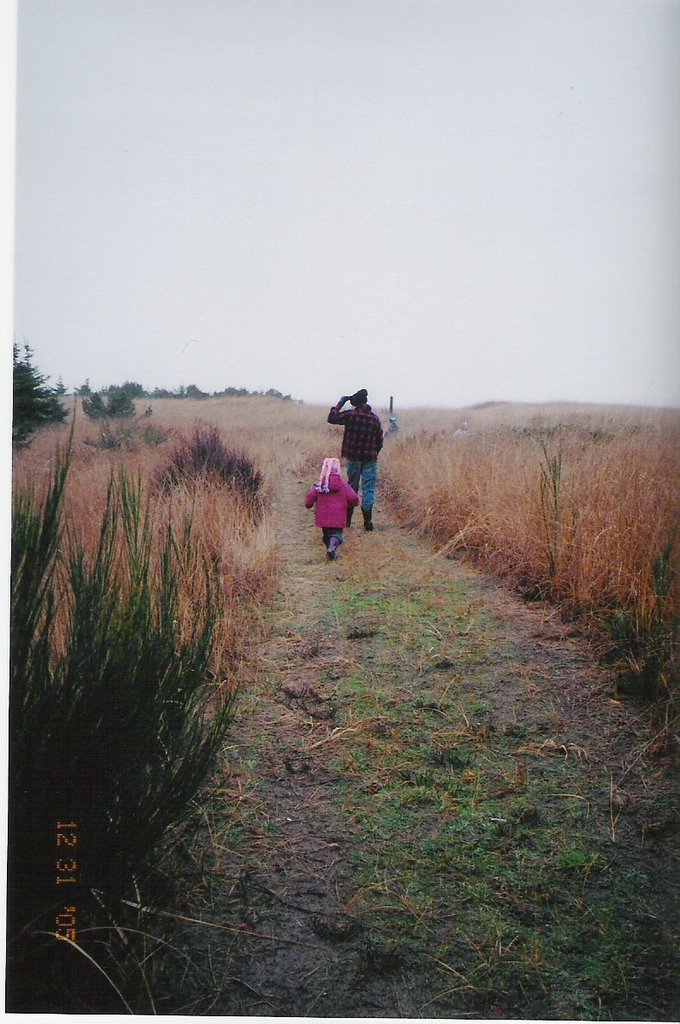
Here is the path to the shore. You can see one of my 12-year olds and my 3-year old, hurrying for their first glimpse of the beach.
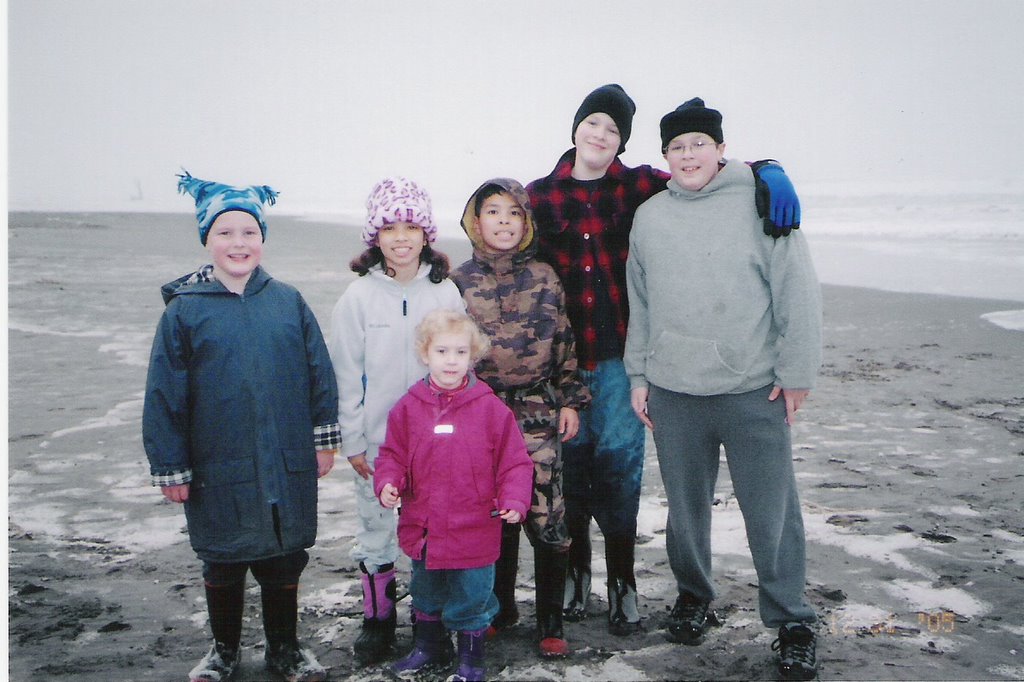
And here are all the kids. Notice the foamy beach. Later on, the foam skittered across the wet sand and my daughter jumped over it with glee.
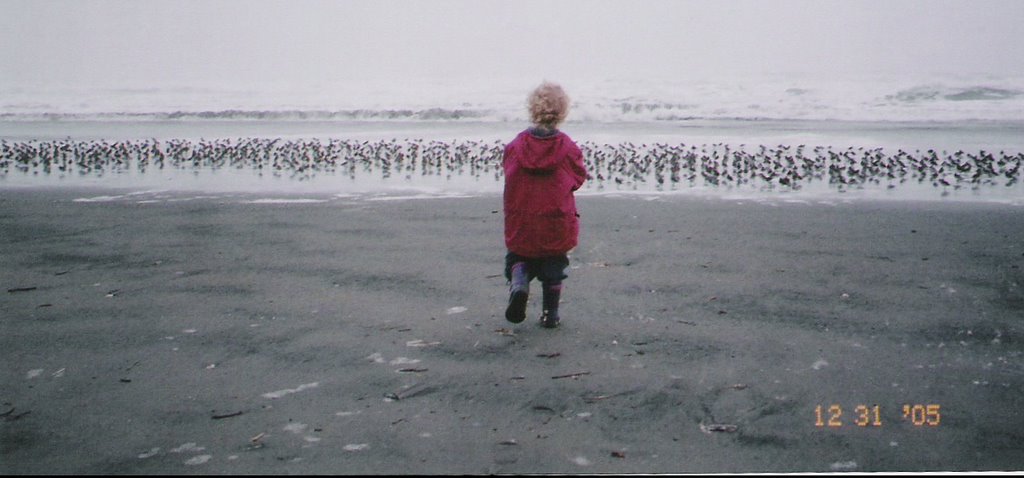
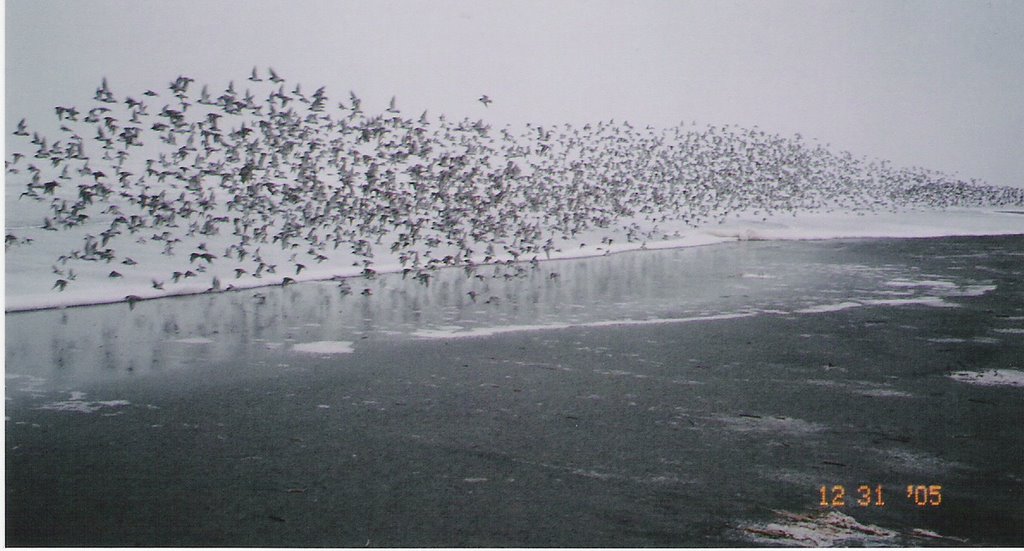
And here is the foam-jumper herself. She fully intended to swim in the ocean, but settled for running at shore birds until they swooped into the air and formed an undulating flying ribbon.
Look out, Sandpipers!

There they go! (Click on pictures for full-size views.)

Something About Last Weekend to Tide You Over

A little more than twenty years ago, I was working for Heritage USA, the brainchild of Jim Bakker. Mr. Bakker (as we learned to refer to him) wanted a high-quality vacation destination designed specifically for Christians. I knew nothing about Jim Bakker and his lovely mascara’ed wife, Tammy Faye, when recruiters came to my college campus that spring of 1985. But a guy I knew named Bill said it would be fun, I should go for an interview and before I knew it, I was driving east in Bill’s hatchback car, heading for Fort Mill, South Carolina, and a summer job.

Six weeks into the summer, my summer-job roommate (who’d managed to make our former Motel 7 room with shag aqua carpeting look marginally appealing with the magic of indirect lighting) dragged me to a Bible study gathering. I had avoided these sorts of events because frankly, after two years of Bible college, I was kind of Bible-Studied out. I couldn’t bear sitting through another emotional session of “sharing what the Lord has laid upon my heart.”

Hey, so sue me. I must tell the truth, nothing but the truth, so help me, God. I didn’t want to go, but I went, mostly because the guest speaker was someone who was the son of someone famous. (Let’s just leave it at that, shall we?) The students sat in a giant circle on the floor. As a “let’s get to know each other” sort of ice-breaker, we were instructed to say a few words about ourselves: where we went to college, what our future plans were.

The fun began and one after another pious student declared his or her super-spiritual life-plan. For instance, “My name is Suzie-with-the-big-hair-from Tennessee and God has called me to minister to inner-city people who don’t have shoes,” and “My name is John-with-the-swagger-from-New-York and God has given me the gift of evangelism–my tapes are on sale at the back of the room.” Maybe you have to grow up in a Pentecostal home to really appreciate the utmost seriousness with which young Bible college students regard themselves and their “call to ministry.”

I was a bit disillusioned already, plus I was sick of college boys, so I concentrated on not rolling my eyes as my turn approached. I was nearly the final person to speak and so, when it was my turn, I proclaimed, “My name is Mel and I attend ________________ Bible College and when I grow up, I’m going to be a rock star.”People laughed and the meeting went on.

Within a few days, I’d met my now-husband, a man who noticed me first at that meeting when I issued that ridiculous proclamation. He and his friend (let’s call him Rich) had said, “We have to meet that girl!” because apparently they appreciated my humor.

So, fast forward twenty years. I say all that because you should know that I have Jim Bakker to thank for my weekend. You see, Rich and his wife, (who I promised to describe as breathtakingly beautiful, bright, and at her goal-weight–oh, and did I mention that Rich is a tall, wry, funny guy?) invited us to their family cottage at Long Beach, Washington, to dig razor claims over the New Year’s holiday. We’ve been friends for twenty years, which on one hand, seems impossible because I’m only twenty-two in my brain, yet on the other hand, I can remember events from twenty years ago as if they were last week. Time is warped.

Did you know you can only dig razor clams during six prescribed time periods in Washington State? Despite being almost a native of Washington State, (I moved here when I was four) we have never been razor-clam digging before, so we looked forward to this new adventure and accepted the invitation eagerly. Did I mention that we also like free accomodations, that we adore our friends, plus, we’re hoping that Rich’s wife’s parents will adopt us, especially since her father has excellent toys and can build houses with his own two hands and her mother is the hostess with the mostest, a woman worthy of emulation? And last but not least, they live on a lake when they aren’t vacationing at the shore. What’s not to love?

Rain has drenched our green corner of the world the past few weeks, yet Saturday morning when we bundled up and walked from the cottage to the beach, the skies were dry and we discovered a calm, windless shore. I removed my jacket, in fact. The crashing waves mesmerized the children, so they raced to the foamy edges and then scambled out of the way. My husband (aka Mr. Safety) warned them repeatedly to watch out and then, a rogue wave pounced on him and my blue-eyed twin, drenching them to their thighs. After that, we were all a lot more careful.

A few hours later, when my 3-year old ocean-loving daughter and I returned for a second walk along the shore, the wind had picked up, and by low-tide that evening, a steady, cold wind blew. At 5 p.m., we twelve (Rich and his wife, their twins (boy/girl), and the wife’s parents, and my family of six) drove in three vehicles onto the beach (that stretch of beach is an actual state highway, strangely enough) and down to the section where we intended to pluck clams from their sandy beds by lantern-light.

Along the darkening shoreline, a string of lantern-lights bobbed, as far as you could see in each direction. Soon, the sunlight faded entirely and only faint starlight and lanterns illuminated our way. We broke into three groups, circling a lantern and stomping along in the low-tide sand. Occasionally, someone would yell, “WATER!” and we’d grabbed lanterns and children and scurry out of reach of the waves. Even better, someone would yell, “I HAVE ONE!” and then someone would plunge a clam-gun (pictured on that website) into the sand and twist, twist, twist it, and then pull up a core of sand. A boot toe would nudge the exposed sand and the clam would be revealed. The hunter would scoop it up, drop it into a net and then, stomp around some more, peering in the dark for the telltale pucker in the sand which indicated a clam beneath. (When you stomp, the clams dart into their shells, which leaves an indentation in the sand.)

(Low-tide happened to be in the evening–and that’s why we hunted in the dark. Sometimes clamming takes place in daylight.)

My 3-year old was bundled in snowpants, a coat, a hat, and mittens and seemed a little chilly, but really, the ghostly waves sneaking up in the dark were the real reason she and I abandoned the clam-diggers for the relative warmth of Rich’s truck. We sat for half an hour in the vehicle, listening to a CD and watching distant hovering balls of light through the foggy windshield. Then she said she wanted to go back (“I will not be scared anymore. I promise!”) and so we traversed the dark shore again, heading toward the lights. We rejoined our group and orbited the pools of lantern-light, hunting for quarter-sized circles in the sand.

Then the rain came and most of us headed home because we’d had enough. (The limit is fifteen razor clams per person and we didn’t find that many. Our haul was more like sixty, I think. I even dug one up myself.)

That night, I sent my kids to bed by 10:00 p.m., even though it was New Year’s Eve. They didn’t protest much since they were exhausted by brisk ocean air and the day’s strenuous activities. Even though I’d been nodding off, at 11:45 p.m., I joined Rich’s wife, her parents and her children (the irrepressible 9-year olds who never once seemed tired) and we drove down to the boardwalk where we saw about the New Year’s fireworks, which lasted about three minutes. We wore silly glasses and posed for photos in the dark and were back home by 12:15 a.m.

We slept two nights at our friend’s newly remodeled and gorgeous cottage. I, for one, was awed by the multitude of outlets available in every room and the well-thought out lighting. In the bedroom I used were five light-switches . . . talk about living in the lap of luxury! From the new second-story, we could gaze out at the crashing gray waves or watch satellite television or squint through a high-powered telescope while sitting on leather couches.

I thought about slipping into a closet and never leaving, but alas, the children found all the good hiding spots when they played hide-and-seek, and besides that, who would wash all the sandy laundry when we got home if I were mysteriously “lost at sea”?

Last Day of Summer

I was halfway through the day when I realized that today is the sixteenth anniversary of my dad’s untimely death. He was forty-seven. He died on the last day of summer.

I remember odd things. The neighbors across the street brought over a homemade version of Dairy Queen’s Peanut Buster Parfait. I can still taste the rich chocolate. I have the recipe, but I’ve never made it myself.

My sister (the one who doesn’t speak to my anymore) arrived at the house too late. My dad had already died. I’ve never heard a human being wail as she did when she heard the news.

I wore a black wool sweater dress to the funeral, which I planned myself. My uncle conducted the service. Dad died on Thursday and the funeral was on Saturday morning. I was completely composed and dry-eyed until the moment when I realized I would be escorted down the center aisle of the church to sit in the front rows reserved for family. I wept as I walked up the aisle because my mind flashed back to my dad walking me up the aisle in my wedding dress only two years earlier.

I could not stop crying.

When the funeral ended and the church emptied out, I turned and saw a vaguely familiar face. Near the back of the church, a man sat alone. That man was my uncle, the brother from Wisconsin my dad hadn’t spoken to in years and years. They were estranged. Days later, I found a typed copy of the letter my dad had sent to his brother years earlier–that letter said, “We never liked each other anyway. Just tell your children you used to have a brother and now he’s dead.” It was a long letter, full of hurt and anger.

I ripped up that letter, determined to end that feud forever. Now, I kind of wish I’d kept it.

So it was bittersweet seeing my uncle at my dad’s funeral.

My brother wasn’t there at all. He’d been estranged from my dad, too, and didn’t reach news of my father’s illness until after his death.

After the funeral, I changed into a cotton dress with kelly green stripes. The weather had warmed up and I just couldn’t stand the wool anymore. So, all the post-funeral, quasi-famiy reunion pictures show everyone in solemn clothing and me in a very 1980s cotton green striped frock. I regret that.

My dad hated his last job. He worked for a newspaper as a technician. He despised the union he was required to join. That union sent a gorgeous plant to the house when my dad died. That beautiful plant dropped its leaves, one by one, died little by little. I watered more. I watered less. I fussed and coddled that plant. And then I saw it had bugs. And then it died.

When I had a garage sale after my dad died, someone stole his pool cue right out of my driveway. I’m still bitter about that, even though it only cost about $125.00. Who steals a dead man’s pool cue from a garage sale? I hope that person was impaled on that pool cue. (Okay. Not really.)

My dad was a ham radio operator, a computer geek before there were computer geeks, a fan of Paul Harvey and Johnny Carson. He dabbled in photography, community theater and painting. He rode a motorcycle across the country. He drove a compact car back and forth to Ohio to visit his father, sometimes in the snowy winter. He stood in his bare feet in the snow at Mount Rainier just for the sake of a funny photograph. I always laughed at him prancing through the house singing, “I feel pretty! Oh so pretty!” and “Tip-toe through the tulips . . .!”

He hardly ever cooked, but when he did it usually involved buying a complete set of aluminum mixing bowls or a new set of knives. He loved kitchen gadgets. The only thing I recall him cooking, though, involved warm cantaloupe, which turned my stomach. He loved chocolate chip cookies and warm pudding with a splash of milk. He was the strong, silent type, a crusty guy who hid his gooey soft heart with a gruff exterior.

And the seasons continue to change, dragging us along by the hand, even as we look backwards for one last glimpse.

Personal Legends

When I was six years old, my dad asked me as we passed in the hallway of our tiny rambler, “What do you want for Christmas?” And I said, “A puppy.” He snorted and said, “Fat chance.” (Or maybe it was something more gentle, but it recorded itself as “fat chance” in my brain.)

At Christmas, a wiggly box was placed upon my lap and I lifted the green-wrapping papered lid to find a black poodle. I named her “Midnight” and she was the star of many of my crayon drawings.

The following October (1972), my mother gave birth to my sister (at home, with no midwife–now, that is quite a story which has nothing to do with this post). Shortly thereafter, I returned home from second grade to find every trace of my puppy gone. No water bowl. No food bowl. No puppy. My parents thought a sudden disappearance would be best.

Recently, I mentioned Midnight to my mother and she has no recollection of that dog whatsoever. None. I began to wonder if I made up that story in my head, if I created some kind of personal myth that became more real the more times I told it.

I know a picture exists of me and that puppy. I know it.

The other day, I passed a television showing coverage of Hurricane Ophelia. The caption said, “Nag’s Head,” and I remembered the time I slept through a hurricane in Nag’s Head, North Carolina in 1986.

Then I started to wonder if this were another legend I made up in my head. So, I stayed up way too late, googling around, searching for evidence that Nag’s Head, North Carolina, was, indeed, hit by a hurricane in 1986.

And it was. Hurricane Charley hit in August 1986, but the winds of 90 miles per hour did little damage.

It’s true, then. I slept through that hurricane. Evacuations were not mandatory, so our drama troupe of college kids hunkered down at the church where we were staying. It was shaped like an ark, that church. I crawled into a bed and collapsed and later discovered I was sharing it with a curly-haired bass-player who was suffering from jock-itch. His name was Dana. Probably still is.

I slept while the storm raged because I had an undiagnosed case of mononucleosis. When the storm passed, my then-boyfriend (now-husband) drove me to a clinic where a doctor asked me to remove my shirt so he could diagnose my sore throat. I still remember the nurse’s raised eyebrows, but I was too sick to object.

When my dad married my stepmother in 1977, she brought into our family her own cache of personal legends. I heard over and over about her handsome, tall, English boyfriend named John and about her job working at Orcas Island during the summers. She’d talk about college and her degree in political science and about orchestras and symphonies and marching bands and how she lost twenty pounds in college by shunning potatoes and bread.

And eventually, all the stories started to repeat, as if they were on a loop. I suppose that happens to all of us. At some point, we run out of stories and pretty soon, we start to accessorieze the stories we tell. How much is truth and how much is embellishment? Will people we love stop us if we tell the same story too many times? Or will they politely listen, much as I listen to the stories my mother and my stepmother tell?

And can I find a picture of the black puppy I am sure I had when I was 6? If I do (when I do), you’ll be the first to know.